Platform
 Grid-Edge DERMS
 Customer Engagement
 Demand Forecasting
 BYOD
BYOD Customer Engagement
 Demand Response
 EV Charging
 Incentive Processing
 Program Design
 Program Management Automation
 Localized Dispatch
 Virtual Power Plants
 API Integrations
 C&I
C&I
To our colleagues at Investor-Owned Utilities (IOUs): Let’s be frank. Your current, century-old approach to balancing supply and demand is buckling under the weight of 21st-century challenges. With electric demand continuing to rise, driven by AI and data centers and compounded by tariffs and supply chain challenges, utilities are struggling to meet their ambitious megawatt goals. Fortunately, virtual power plants (VPPs) are a powerful tool in enhancing the firm capacity needed to meet skyrocketing electric demand.
The Grid Crisis Is Already Here
The truth is, the classic strategies of relying on centralized generation and decades-old legacy load control are no longer sufficient to guarantee reliable service for your customers in 2026 and beyond, for a few reasons.
- Massive load growth: The rapid, uneven, and largely unpredictable growth driven by electrification (EVs, heat pumps, and smart devices) and AI data centers is creating unprecedented demand spikes. Your traditional forecasting models simply can’t keep up.
- Generation headwinds: Despite costly deferrals, coal and gas retirements largely continue, and while renewables are expanding, the pace of interconnection for firm capacity is lagging. The reliability gap is widening, and expensive peaker plants are being run harder than ever.
- Customer expectations: Your ratepayers are adopting distributed energy resources (DERs)—rooftop solar, home batteries, and smart thermostats—at an exponential rate. These assets are transforming the grid edge, often without your visibility or control, introducing new operational complexities.
The result? Increased stress, higher costs for all stakeholders, and a growing risk of the very thing we are all committed to preventing: blackouts and brownouts.
The Answer Isn’t More Wires, It’s More Software: The Rise of the Virtual Power Plant (VPP)
You need a new source of reliable, dispatchable capacity that is fast to deploy and cost-effective. The answer is a virtual power plant (VPP).
As the name implies, a VPP is not a physical power plant; it’s a software-driven platform that aggregates and manages thousands of geographically dispersed DERs—from residential smart devices to C&I battery storage—making them operate as a single, coordinated, and reliable resource. Virtual power plants can benefit utilities through:
- Load shifting: A VPP can automatically charge EV batteries when solar production is high and delay charging when the grid is stressed.
- Peak shaving: It can seamlessly discharge a fleet of home batteries during the critical 4 PM to 8 PM peak, instantly reducing load and avoiding the need to fire up an expensive, polluting peaker unit.
- Cost-effective deferral: By reducing peak demand, VPPs provide a non-wires alternative (NWA) that can defer billions in costly, multi-year infrastructure upgrades (substations, transformers, lines).
- Topline Demand Control: Using Topline Demand Control (TDC), which combines AI, forecasting, model predictive control, and the Shift Grid-Edge DERMS, utilities can optimize their virtual power plant strategies to guarantee their preferred outcome, operationalizing behind-the-meter DERs.
Virtual power plants can transform a fleet of disparate, customer-owned assets into a dependable resource that provides the firm capacity your system requires, at 40-60% the cost of conventional power plants. As a powerful demand flexibility tool, research indicates that enhancing virtual power plant strategies can meet 20% of U.S. peak demand. Through the use of software like Topline Demand Control, utilities can leverage behind-the-meter DER assets as virtual power plants, while resting easy that, through AI-informed forecasting, their megawatt goals can be met.
A Critical Distinction: Grid-Edge DERMS vs. Grid DERMS
Realizing the full potential of virtual power plants requires moving beyond siloed control systems and embracing a sophisticated, two-pronged distributed energy resource management system (DERMS) approach that combines both Grid-Edge DERMS and Grid DERMS.
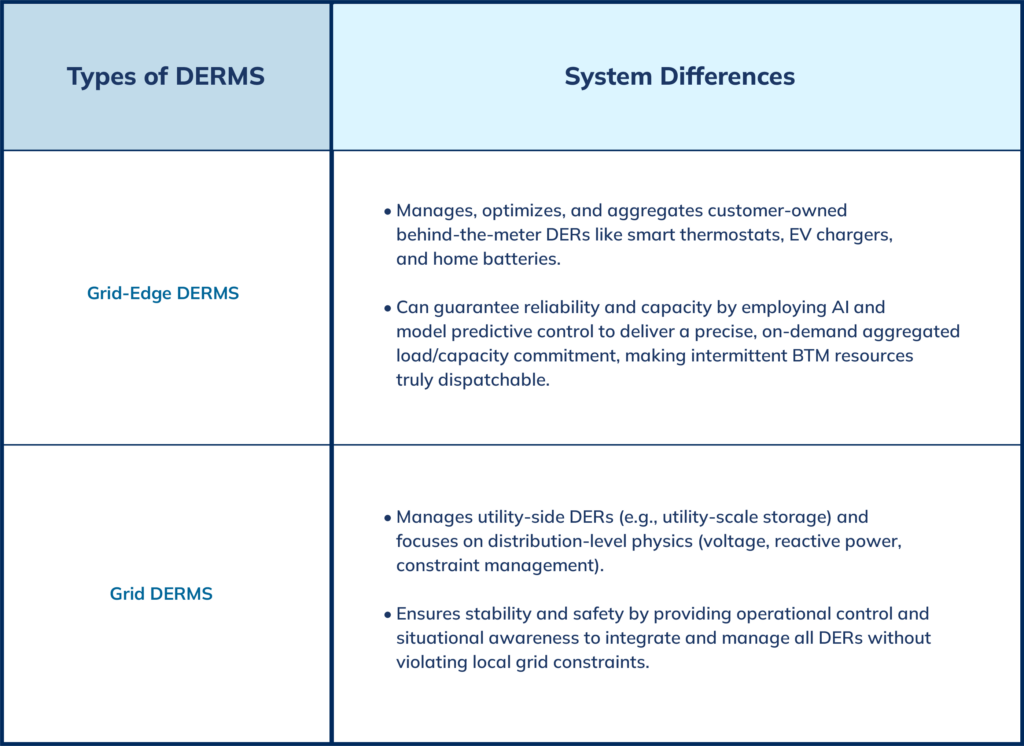
A next-generation VPP solution not only guarantees a reliable output but also provides a comprehensive solution that encompasses all DER types. That includes tapping into the power of BTM DERs, while leveraging utility-held DER assets to foster a holistic load management system. For a robust, future-proof grid, Grid-Edge DERMS must integrate seamlessly with your Grid DERMS. This integration creates a reciprocal ecosystem in which the aggregated capacity from the customer side is reliably delivered and managed within the physical distribution network.
Conclusion: The Future of Reliability is Distributed
This year is not a time for small, incremental change, but taking strident steps toward energy security and enhanced grid resiliency. For IOUs facing mounting electric demand, necessary plant retirements, and immense pressure from tariffs and supply chain challenges, virtual power plants are moving from a strategic pilot to an existential necessity, a powerful tool in enhancing grid resiliency, while lowering operational costs.
By investing in an advanced Grid-Edge DERMS —and ensuring its deep integration with your Grid DERMS—you gain:
- Guaranteed capacity: A reliable, flexibly dispatchable resource that reliably shifts load and shaves peak demand with a solution like Topline Demand Control.
- Affordability: A far less capital-intensive alternative to building new generation and T&D infrastructure.
- Customer empowerment: A system that engages, rather than ignores, the millions of BTM DERs your customers are already installing.
The lights-on challenge is not going away. The path to a resilient, affordable grid starts at the edge. It starts with virtual power plants.
Operationalize Distributed Energy Resources With Topline Demand Control