Platform
 Grid-Edge DERMS
 Customer Engagement
 Demand Forecasting
 BYOD
BYOD Customer Engagement
 Demand Response
 EV Charging
 Incentive Processing
 Program Design
 Program Management Automation
 Localized Dispatch
 Virtual Power Plants
 API Integrations
 C&I
C&I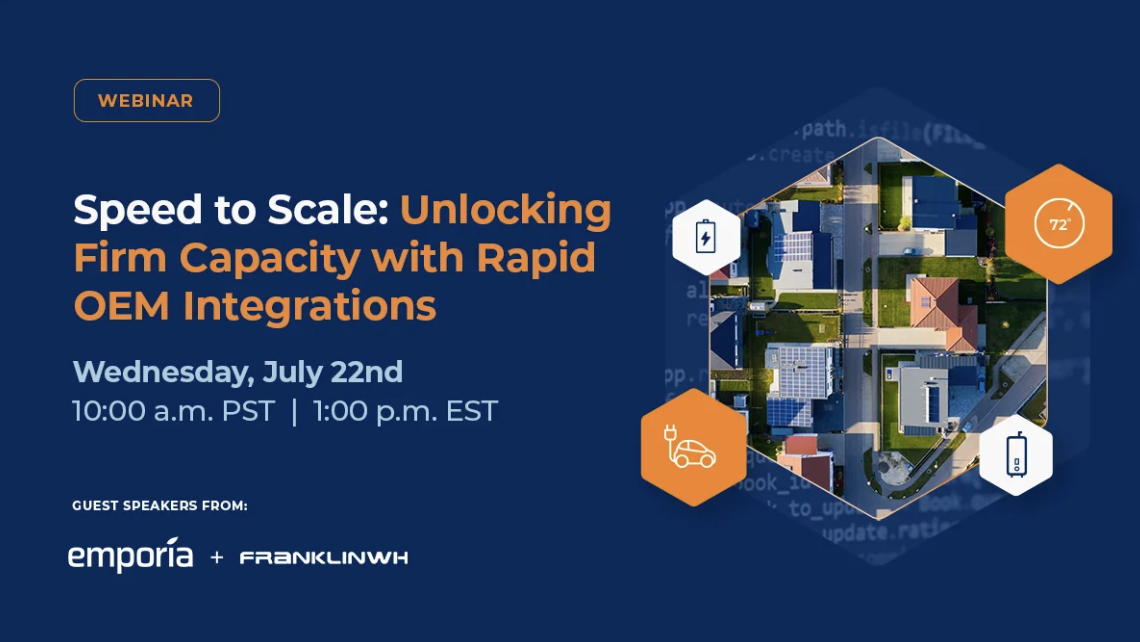
On July 22, 2026, Virtual Peaker hosted a live discussion, “Speed to Scale: Unlocking Firm Capacity with Rapid OEM Integrations,” bringing together speakers from Virtual Peaker, Emporia, and FranklinWH to talk through how a virtual power plant built on multiple device types can move from pilot to full-scale program faster than most utility teams expect. With utilities across the country under pressure to quickly add firm, dispatchable capacity, this article recaps the session’s key themes, including why utilities are scaling now, what makes multi-device programs manageable rather than messy, how trust and reliability get built into a program from day one, and what real utilities have seen when they made enrollment simple.
In This Article
- Why Utilities Are Scaling Now
- Multi-OEM Scaling Made Easy
- From Pilot to Scale: Integration Best Practices
- Building Trust & Reliability at Scale
- Real Results from the Field
- The Role of Open Standards & Interoperability
- Frequently Asked Questions
- Glossary of Terms
1. Why Utilities Are Scaling Now
The panel, which included Katarina Struckmann (API product manager, Virtual Peaker), Ben Thacker (EVP of business development, Emporia), and Matt Hale (grid services, FranklinWH), opened by naming the forces pushing utilities to move past pilot programs. Market regulations increasingly require firm capacity and reserve margins, energy prices continue to climb, and many utilities are running up against real capacity constraints on their existing grid. At the same time, plenty of utilities already have one-off pilots proving the underlying model works — the challenge now is graduating those pilots into programs that actually move the needle on peak demand.
As the speakers noted, scaling fast has three concrete payoffs:
- Faster capacity additions without new physical infrastructure
- A more resilient and diversified distributed energy resource (DER) portfolio
- Stronger cost-per-kilowatt as programs grow.
None of that requires waiting on a new substation or generation asset — it requires making better use of the devices already installed in homes and businesses.
2. Multi-OEM Scaling Made Easy
A recurring theme of the webinar was that adding multiple device types and original equipment manufacturers (OEMs) to a single program is far less risky than it sounds. Multiple device types are ready to deploy today, multi-device program structures are already proven in the field, and — perhaps counterintuitively — working with multiple OEMs adds resilience rather than complexity. A diversified device mix means a utility isn’t dependent on a single hardware partner’s supply chain, firmware roadmap, or customer base.
That said, the panel was candid that adding a new device type does shift some things: contract terms and program design both need to flex, and utilities should expect to work through a checklist covering event frequency, dispatch behavior, and program design, since these vary by device type. The speakers also pushed back on common cost myths, noting that set-up fees and the expense of hosting multiple device types are often overstated compared to the capacity gains they unlock.
3. From Pilot to Scale: Integration Best Practices
Rather than reinventing program design for every new device or partner, the panel encouraged utilities to borrow what already works. That means escalating existing pilots while still meeting program requirements, maximizing current resources before adding new device types, and reusing incentive strategies and program structures that have already proven successful.
A few practical integration best practices came up repeatedly:
- Choose a distributed energy resource management system (DERMS) platform that offers native device integrations along with the flexibility to add more through open, standardized protocols.
- Build interconnection and net metering considerations into the program design from day one, rather than retrofitting them later.
- Simplify enrollment. Pre-enrollment and one-click sign-up were both cited as the difference between marginal and outstanding participation rates.
- Streamline contracting and credentialing with device partners so that onboarding a new OEM is a repeatable process rather than a custom project every time.
4. Building Trust & Reliability at Scale
Scaling a virtual power plant only matters if utility operators can trust the capacity is actually there when they need it. The panel outlined what builds that trust: the ability to see available capacity and measure results in real time, treating the program as an integrated grid resource rather than a break-glass emergency tool, and giving operators visibility into OEM-side data so they can understand the full scope of what’s available.
On the reliability side, the speakers pointed to control architectures and data standards that reduce data latency, along with the predictability and dispatch certainty that grid operations require. In other words, reliability isn’t something added after the fact — it has to be designed into the integration architecture from the start.
5. Real Results from the Field
Each speaker emphasized the need for monitoring and measuring results to demonstrate programmatic growth. For example, speaker Matt Hale discussed how simplifying enrollment led to exponential program growth. Katarina Struckmann also spoke to multi-device program examples and how utilities can reach residential customers who already own multiple eligible devices, rather than treating each device type as its own silo.
6. The Role of Open Standards & Interoperability
A significant portion of the session focused on why open standards matter for long-term scaling. Standards compliance and certification give utilities vendor flexibility, streamline how different distributed energy resource (DER) types are integrated, and help programs avoid stranded assets as technology evolves. The panel also walked through system interoperability considerations: SCADA and ADMS integrations bring full network awareness into DER dispatch decisions, improving both the granularity of demand response calls and real-time monitoring. Advanced metering infrastructure (AMI) integration adds further behind-the-meter visibility, including power quality data and inverter-based control.
Integrations like OpenADR or Gravity Connect for grid-edge and grid DERMS were also highlighted as a way to bring front-of-meter and behind-the-meter DER strategies together under a single management view, while CRM integrations help utilities verify enrollment against the customer file in real time. As the panel summarized, the keys to a successful integration are describing the goal clearly, understanding the end user’s context, and defining success criteria before a single line of code gets written.
Virtual power plants are defined as a connected aggregation of distributed energy resources that supports demand flexibility initiatives like demand response and EV charging. The webinar’s central argument was that this aggregation gets easier, not harder, as more device types and OEMs are added — provided the underlying platform and standards are built for it.
Frequently Asked Questions
What is a virtual power plant? A virtual power plant is a network of distributed energy resources, such as batteries, smart thermostats, water heaters, solar installations, and EV chargers, that are coordinated together to act like a single, dispatchable power resource for the grid.
Why does adding more OEMs make a virtual power plant program more resilient instead of more complicated? Relying on a single device manufacturer means a utility’s entire program is exposed to that manufacturer’s supply chain, firmware, and customer base. Spreading capacity across multiple OEMs and device types diversifies that risk, and modern integration standards mean each additional device type doesn’t require a custom-built process.
How much does enrollment design matter to program scale? Significantly. The webinar cited a real-world jump from roughly 5% to 80% participation tied largely to removing friction from the sign-up process, underscoring that technology readiness alone isn’t enough without an easy path for customers to join.
What role do open standards play in scaling a demand flexibility program? Open standards reduce vendor lock-in, simplify how new device types get integrated, and protect a utility’s investment from becoming a stranded asset as the market evolves.
Do utilities need to build new infrastructure to add firm capacity this way? No. The premise of the discussion was that firm capacity gains can come from better utilizing devices already installed in homes and businesses, rather than from new generation or grid infrastructure.
Glossary of Terms
- Distributed energy resource (DER): A small-scale energy asset, such as solar, battery storage, an EV charger, or a smart thermostat, typically located on the customer side of the meter.
- Distributed energy resource management system (DERMS): A software platform that aggregates, monitors, and controls DERs to support programs like demand response and virtual power plants.
- Grid-Edge DERMS: A DERMS focused specifically on managing behind-the-meter DER assets in residential, commercial, and industrial settings.
- Virtual power plant (VPP): A coordinated aggregation of DERs that is dispatched and managed as though it were a single power plant.
- Original equipment manufacturer (OEM): The company that manufactures a device, such as a battery, thermostat, or EV charger, that participates in a demand flexibility program.
- Battery energy storage system (BESS): An installed battery system, often residential, that can store and discharge power as part of a demand flexibility program.
- Supervisory control and data acquisition( SCADA): A control system utilities use to monitor and manage field equipment and processes across the grid.
- Advanced distribution management system (ADMS): A utility platform that provides visibility and control over distribution network operations.
- Advanced metering infrastructure (AMI): The network of smart meters and communication systems that gives utilities behind-the-meter usage data.
- OpenADR: An open communications standard used to automate and standardize demand response signaling between utilities and devices.
- Behind-the-meter (BTM) / front-of-the-meter (FTM): Terms describing whether a DER asset sits on the customer side (behind) or utility side (front) of the electric meter.
6 Takeaways About Virtual Power Plants from Our Speed to Scale: Unlocking Firm Capacity with Rapid OEM Integrations Webinar Conclusion
Recent research indicates that even more demand growth is on the horizon, leading some to rethink generation plans. Virtual power plants support these objectives by leveraging an available and proliferating asset: distributed energy resources (DERs). Through the right Grid-Edge DERMS platform, utilities can quickly scale their programmatic offerings, while engaging the customer rapport needed to encourage both enrollment and continued participation in demand flexibility programs.
Did you miss the webinar?